Poker Basic Strategy
Introduction to basic poker strategy concepts used throughout this site and the book.
In poker, the position of a player at the table is one of the most important factors in determining their strategy. The position of a player is determined by their seat at the table relative to the dealer button, which rotates clockwise around the table after each hand.
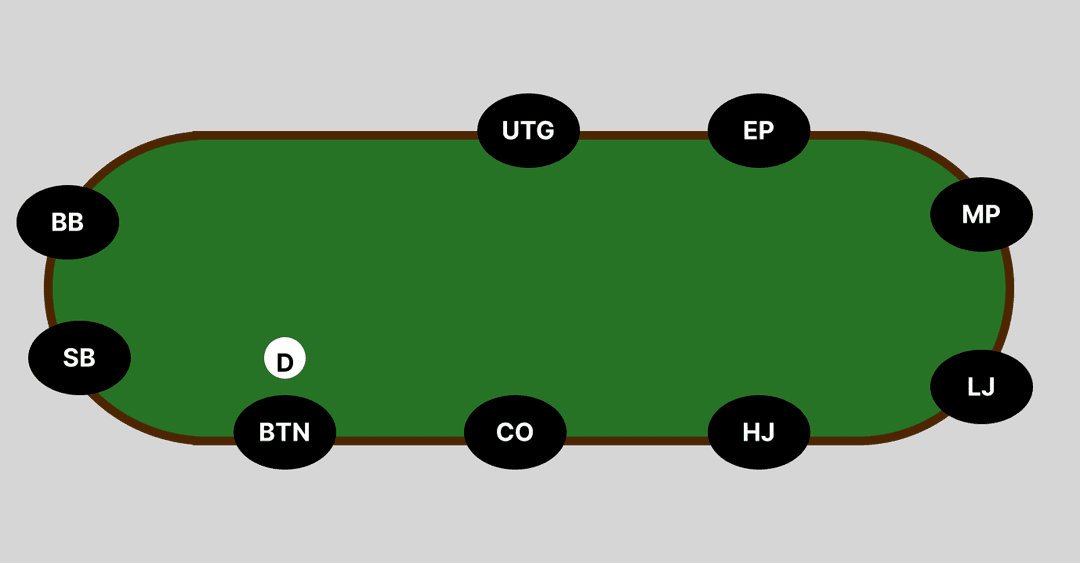
- Big Blind (BB)The big blind puts in the opening bet. In a $1/$2 No Limit game, the big blind will be $2. A typical stack size is 100x the big blind, so $200 in a $1/2 game. The big blind acts last preflop, but second after the small blind on the flop, turn, and river.
- Small Blind (SB)The small blind puts in half of the opening bet. In a $1/$2 No Limit game, the small blind will be $1. The small blind acts second-to-last preflop, and first postflop.
- Button (BTN)The button is the best position in poker as it acts last postflop. Preflop, it acts third to last, before the small blind and big blind.
- Cutoff (CO)The Cutoff is the player who acts before the Button.
- Hijack (HJ)The Hijack is the player who acts before the Cutoff.
- Lojack (LJ)The Lojack is the player who acts before the Hijack.
- Middle Position (MP) and Early Position (EP)Middle position and early position are less precisely defined. Middle position is usually the player who acts before the Lojack, but sometimes the Lojack is considered Middle Position. Early position is usually the first or second to act.
- Under the Gun (UTG)Under the the gun is the first player to act. Sometimes it's clarifid exactly its position with a number, for example, UTG7 would be the first player to act 7-handed.
- Stradde (STR)The straddle is an optional third blind. As it's a third blind, it acts last preflop (after the big blind) but third postflop (after the small blind and big blind). Straddles are common in live poker, and in some games the whole table is straddling in which case straddling is mandated by etiquette. The straddle is not pictured in the diagram above, but you can imagine the UTG player "becoming" the straddle / third blind.
In poker, the size of a player's stack is often measured in big blinds (BB). In a $1 / $2 game, a $200 big blind stack would be 100BB.
In poker strategy, it's best to analyze stack sizes relative to the big blinds. That's because all strategy is dictated by the incentive to win the existing pot. Without an existing pot, there'd be no reason to enter a hand. What we care about is the size of the pot relative to what we risk to win it. This is called the stack to pot ratio (SPR).
Imagine a $1 / $2 game with a $20 pot and a player having $200 stack behind. The SPR in this case is 10. The strategy considerations here would be exactly the same in a $100 / $200 game with a $2000 pot and each player having $20,000 stacks behind. The mathematical ratios of risk to reward would remain the same - this is why poker strategy writers consider only big blinds and SPR, but not absoute dollar values.
The other important concept is effective stacks. In no-limit hold'em, the most you can bet is the amount in your stack. But if your opponent has less than you, the most you can bet is the amount in their stack. So the effective stack is the smaller of the two stacks.
For example, suppose you had a $150 stack and your opponent had $100 stack. The effective stack is $100, because you are unable to bet the remaining $50, as your opponent can't call it, so it's irrelevant to the strategy.